jeudi 10 juin 2010

Opium: "poison de rêve" and Russia's nightmare


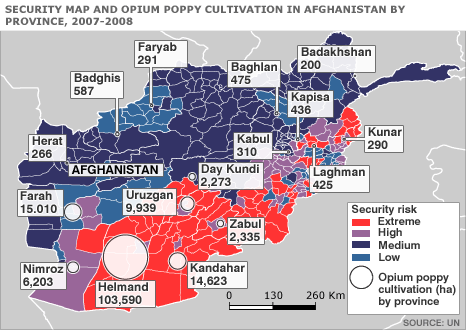
As to answer NATO's ongoing offensive in Southern Afghanistan, an international forum dedicated to the issue of Afghan narcotics started in Moscow yesterday. A few days earlier, Russia's defence minister made clear the Kremlin's disappointment regarding what it considers as insufficient efforts by NATO forces to fight poppy cultivation in Afghanistan. The question is of paramount importance to Russia, far more than to most NATO countries.

Narcotics in Central Asia; from local use to global trade

Climate in many regions of Central Asia and Afghanistan perfectly suits cultivation of crops such as hashish, poppy or ephedra, which serve as raw materials for several psycho-active substances. Logically, the locals quickly learned to use these plants for relaxation or medicinal purposes (one can think of the use made of opium as a painkiller in Joseph Kessel's Horsemen).

 Poppy cultivation in Afghanistan and, to some extent, Central Asia (under soviet rule till recently) did not quickly increase before 1979 and the beginning of Soviet involvement in Afghanistan. This growth is due to the conflict itself (the mujaheddin used opium as a source of income to fund their jihad) and to measures of interdiction taken in several countries (Turkey, Pakistan to some extent and Iran after the Islamic Revolution). Following the Soviet withdrawal and the expansion of the civil war, poppy cultivation further increased. Indeed, since US aid had stopped, warlords used drug trade to fund their militias, while peasants had found with opium a valuable crop in these troubled times. Finally, poppy does not require as much water as other crops to grow, and once harvested it can be kept some times; both things are important in a country where water and roads allowing fast travel to trade centres are scarce.
Genesis of a cancer

Before the arrival of Soviet troops  in Afghanistan, consumption of drugs was minimal in the USRR. However, combat stress experienced by soviet troops (most of them were reservists or draftees) led to a sharp increase in the consumption of narcotics, which created a demand inside USSR. This led to the development of drug rings involving Afghan producers and soviet smugglers, which outlived the end of the war and of the Soviet Union itself. After the collapse of the USSR, poor surveillance of the new borders and generalized impoverishment  created the conditions for large-scale drug trade to thrive. The civil war in Tajikistan further eased the development of continental smuggling rings (all parties resorted to drug trade to fund their struggle), especially due to the presence of ethnic Tajiks on both side of the Afghan-Tajik border and the widespread use of Russian as a lingua franca in former USSR. These rings still benefit from simple migration procedures between Russia and Tajikistan, as well as of the involvement of officials in drug trade (including veterans of the Tajik civil war now holding power seats). Finally, it appears that members of the Russian peacekeeping force in the country used military transports (not subject to controls) to smuggle drugs inside Russia, which prompted Moscow to tighten control over its soldiers abroad.

Because of Iran's bitter fight against drug trade, most of Afghan-made heroin now crosses Central Asia and Russia, whose borders are less tightly monitored. Complex boundaries, rampant corruption and diminishing volumes (smugglers now increasingly process poppy into heroin into Afghanistan rather than shipping raw materials outside of the country) make it harder for law enforcement units to intercept drug shipments. Eventually, transit areas become markets and Russia now has to cope with huge drug trade-related problems that impact its demography, endanger its future and fuel corruption. According to a UN paper, 30.000 Russians die every year because of heroin (one third of the 100.000 yearly toll of heroin addiction), while several millions (estimates range from 1,5 to 6 million people between 15 and 64) are heroin-addicted. Drug addiction also poses public health (HIV spreads through syringes exchanges) and socio-economic long-term problems (over-mortality of heroin-addicted youth, criminalization of the society, and economic weight of a significant population of addicts).

Roots of evil

Russia's growing concern and impatience are due to the importance of the drug trafficking problem and to its origins. Indeed, the take-off of poppy cultivation in Afghanistan occurred with the CIA's silent consent, while opium production kept on growing since the beginning of Operation Enduring Freedom. Furthermore, the ISAF today concentrates on the fight against the insurgency, which draws profits from drug trade but is only one actor among others. Moscow especially reproaches NATO with renouncing poppy crops elimination because such policy would turn rural populations against ISAF forces. These prefer let the Afghan security forces deal with the problem, preferably by destroying labs and already processed heroin rather than burning crops. However, the Afghan National Police is plagued by corruption, and has so far not proved very efficient to tackle the problem

Moscow further denounced Washington's double standards on this issue ; while the US stress the importance not to alienate the population in Afghanistan, they long supported aggressive crops-elimination policies in Latin America, especially in Colombia. Russia also complained of poor cooperation between security forces in Afghanistan (regardless of their nationality) and Central Asian law enforcement agencies.

As a conclusion, it must be stressed that the Colombian experience in the field of counter-narcotics is worth a look and potentially interesting for upcoming operations in Afghanistan. This “Integral Action” doctrine emphasizes the need for coercion (elimination of illegal crops and dismantlement of illegal armed bands) and people-centred operations (population control and aid programs to promote alternative crops). The French armed forces' experience in Easter Afghanistan is also relevant in this domain.


Update (10.06.10): here is a potentially interesting article relased by ferghana.ru (in Russian) dedicated to drug trafficking through Kazakhstan. Let's also note that the subject of narcotics trade from Afghanistan will certainly be on the agenda of the SCO summit currently underway in Tashkent.

lundi 31 mai 2010

Tehran-Moscow axis: strategic partnership or simple "Entente Cordiale"?


The recent announcement of a Brazil-backed agreement between Turkey and Iran, regarding the latter's nuclear program has somehow driven attention away from the sharp deterioration of diplomatic relations between Russia and Iran. Judging by unfriendly official statements, the Russo-Iranian partnership did not survived Moscow's stauncher stance on the Iranian nuclear issue. Not limiting its reaction to mere words, Tehran has taken steps to improve its relationship with Georgia.

Russia's exasperation with Tehran is rooted in the latter's evident lack of goodwill on the nuclear issue. Indeed, Iran agreed to send its uranium abroad, only to withdraw its offer some days after and announce in parallel that it would proceed with enrichment to a higher degree, that was getting Tehran closer from mastering military nuclear process. Finally, active muscle-flexing from Tehran in the last months (war-games in the Gulf and repeated announcements about state-of-the-art weaponry entering service) did little to convince Moscow that Tehran's views are non-aggressive.

Moscow's concerns have been sensible for some time now. Over the past few months, Russia has been accused by Iran of delaying the entry into service of the nuclear plant in Bushehr (built by Rosatom) and of holding up the delivery of S-300 anti-aircraft systems.


Political U-turn or logical realignment?

One could assume that Moscow's new stance is the result of US concessions, of Medvedev's new attitude towards the West or simply of Russia's growing concern of Iran going nuclear. Whatever has triggered Moscow's change of attitude towards Iran, on thing is sure: given the numerous potential conflict points between Russia and Iran, their so-far rather good relationship was more a pragmatic alliance rather than a long-term strategic commitment.

Russia and Persia (whose Iran is somehow the heir) have a long story of rivalry and war, especially in the Caucasus (a fight that the Russians had largely won by the end of the XIXth century). Later on, Persia was placed in the spheres of influence of England and Russia (which was eventually replaced by the soviet union), and even occupied by Allied and Soviet forces during World War II. Finaly, the Islamic Revolution and its message of revolt to Muslims worldwide did not make Iran more friendly in the eyes of the Soviets, worried by the spread of sedition in their Muslim territories and already fighting an Islamic insurgency in neighbouring Afghanistan.
British caricature of the XIXth century, showing the Russian bear subjugating Persia.

Following the collapse of the USSR, Iran sought to break its encirclement by increasing its influence in countries of the former Soviet Union. This policy is still a reality, and Iran has been developing partnerships on various levels with several countries of Central Asia and the Caucasus. It is no wonder then that Moscow sees with apprehension this intrusion of a new rival in what it still considers as its backyard. Especially when this rival has money (thanks to its soil's energy resources), and assets such as cultural, historical and linguistic proximity with these regions. Tensions are not limited to the Caucasus: indeed, Iran and Russia still have to agree on a legal status for the Caspian Sea, which would determine the way the seabed is shared.


Iran is fully aware of these dissensions with Russia. Hence, it has developed partnerships with China, a critical actor of the new "Great Game" and a relevant challenger to Russia influence in Central Asia. Iran today supplies China with part of the energy resources vital to its economic development, while China has already transferred sensitive military technologies to Iran (mainly in the field of ballistic, anti-ship and anti-air missiles).

From rivalry to conflict?

Despite real tensions between the two countries, it is unlikely that either of the two will push the confrontation to a superior level, whether this takes the form of direct armed conflict or proxy-wars. First of all, both Tehran and Moscow have common interest (the first of them being chasing NATO from Central Asia) and important contracts in the military and nuclear sector underway. But both States are also mutually deterred from taking too harsh measures against one another by what equates to a balance of terror.

Iran could, if needed, seriously destabilize the Caucasus, and particularly Russian-controlled parts of the region. The Pasdarans (Islamic Revolution Guard Corps) have accumulated extensive experience in the field of irregular warfare through support for Hezbollah, today one of the most proficient guerilla movements in the world. Indeed, Hezbollah's "know-how" in fields such as ambush tactics, handling of antitank weapons , assembly of IEDs and construction of underground shelters and bunkers could easily be used by Caucasian insurgents evolving in a mountainous environment suitable for guerilla tactics.

Such a move from Iran is however unlikely, given the fact that Russia would, in these event, retain tremendous retaliation capabilities on Iranian assets. And the way Mikhail Saakachvili's 2008 military adventure ended says more than a long speech on Moscow's determination not to let unpunished this kind of provocation...


lundi 24 mai 2010

Winds of change in Uzbekistan?

The most populous state in Central Asia, Uzbekistan today finds itself in an uncomfortable position. Shaken by the world economic crisis, unable to rely on oil and gas exports to replenish its foreign currency reserves, it is furthermore threatened by instability in neighbouring Kyrgyzstan and numerous internal problems.

« It's the economy, stupid »
One could believe that Uzbekistan is doing quite well; it has indeed secured a 1,150 billion USD loan from the Asian Development Bank, the same amount it has so far lent to Uzbekistan from 1996. However, though all this fresh money will certainly relieve a strained budget, it was not without painful concessions from Uzbekistan, which could further provoke discontent among the population. Besides, indicators show that the economy is not doing well, and so on for Uzbekistan's budget.

In the past months, the Uzbek government seems to have taken several measures aimed at raising more funds: it has cut expenses on invalidity pensions, risen taxes on fuel and cars,  and lowered interest rates for private deposits in state-owned banks. This has occurred in parallel with an accelerated devaluation of the national currency (sum), whose « official » price is more and more overvalued regarding the sum/dollar parity on the black market. This most likely means that Uzbekistan is short on foreign currency reserves and unable to support the sum.

The fact the Uzbek government is obviously short on funds might prompt hasty explanations for some of last months' most unpleasant events. For example, widespread arrests of businessmen and oligarchs in march 2010 resulted in rumours that this was simply a way to refill the State's coffers. The same could be stated about the problems currently experienced by Zeromax, Uzbekistan largest private company and reportedly in the hands of President Karimov's daughter and ambassador to Spain, Gulnara (altough such pursuits are more likely politically, and not economically motivated). Finally, the loss by hundreds of their savings in the National Bank of Uzbekistan could eventually prompt rumours that the State is now robbing its own citizens in order to restore balance in its budget.

Growing discontent

The bad and so far deteriorating economic situation plays a big part in the growing exasperation of the population. Hardly hit by the crisis, heavy taxes, political repression and environmental problems, Uzbeks also had to cope, in the last months, with unpaid wages, looming food shortages, as well as more « usual » hardness for the region (power cuts, and poor healthcare quality sometimes resulting in contamination). Furthermore, rumours recently grew that Uzbek authorities had initiated a forced sterilization campaign in order to curb overcrowding in the region. All this does little to appease griefs against the Uzbek government, which has grown increasingly anxious over the past months that unrest in Kyrgyzstan might spread to Uzbek parts of the Ferghana Valley. Indeed, in 2005, an uprising in Andijan closely followed the Kyrgyz tulip revolution. Although its bloody crushing has so far deterred any new protest in Uzbekistan, Uzbek authorities are afraid that the troubles shaking southern Kyrgyzstan could provide opportunities for troublemakers at home.

Musical chairs in Madrid and Tashkent?

Zeromax's current problems should not be separated from the bigger picture of Uzbek politics. Gulnara Karimova, President Karimov's daughter, has long been considered as a possible heir to her father. However, recent developments suggest it might after all not be the case. Indeed, Gulnara is said to be a controversial figure and would thus not make a consensual leader when the time comes to succeed the father. Most important perhaps, she remains a women, and most likely unable to hold power for long in a rather conservative and patriarchal society.

Whether Gulnara Karimova is being forces out of succession or willingly accepting to stay out of politics has no great interest for today. Rather, it would be interesting to know whether or not President Islam Karimov has supported this evolution. Indeed, the worsening situation of the countries and the subsequent fears it could be destabilized may have emboldened some rival clans in Uzbek politics. The recent troubles experienced by Zeromax would thus be the sign of Karimov's diminishing control over the Uzbek state apparatus.

mercredi 19 mai 2010

Feeding the Bear: soviet military logistics in Afghanistan

Scene from the motion picture "9th Company" (9 Рота)

Though Afghanistan has been invaded many times, it has yet never been totally conquered since a foreign invasion force can hardly maintain itself in the country. This is mainly due to harsh climate, terrain and poor communication infrastructure, resulting in a logistical nightmare such as the one experienced by the Soviet Union between 1979 and 1989. In order to face unexpected challenges, Soviet logistics adapted itself to Afghanistan, as did the whole 40th army.

Soviet logistic organizational structure: limits and evolutions

It became clear since the very beginning of the conflict that soviet supply structures, designed for a large-scale conflict against NATO or China was not adapted to a low-intensity conflict involving a smaller number of forces that would-be World War III. In particular, the pyramidal organization intended to give good theatre-level reactivity proved inadequate because it failed to provide good tactical flexibility. Order and supply invariably had to travel the whole command and hierarchical chain, which demanded a lot of time.

Other elements plagued soviet logistics. Among other things, many units deployed initially did not carry with them enough supply and spare parts for this type of conflict, and transport priorities did not match real supply needs (missiles and ammunitions rather than food, medical and fuel supplies, were shipped as soon as possible).

Alleviating and protecting the roads

In the beginning, the Soviets did not plan to stay long, and they organized most supply operations from facilities in the USSR without building any significant one in Afghanistan. However, when the Red Army realized that it was here to stay, it build several important supply depots (in Herat and Pol-e-Kormi) and maintenance facilities (in Herat and Jalalabad) to relieve those in Kabul. Other less important facilities and pipelines were built along the main roads to ease traffic, routine maintenance and driver support.
Map of Afghanistan's road network and main soviet bases.
Credits: Army magazine, January 1988.
Finally, in order to protect this network, the Red Army built numerous bases protected by fortifications, minefields, and garrisoned with troops and artillery. This was however not enough to provide full security, hence the need for convoy escort and road patrols.

Mobile convoy protection elements
Defence of logistical fluxes was indispensable (ambushes often resulted into loss of hardware, sometimes do the mujahiddins, and roads closing for several hours) and required many troops that could not be employed in offensive operations. It must be noted that soviet logistics had to supply the expeditionary force (110.000 men), the Democratic Republic of Afghanistan's (DRA) armed forces and part of the civilian population, which dramatically increased stress on transportation capabilities.

Units patrolled the roads night and day, searching for mujahideens, mines and roadblocks, or simply road sections suitable for ambushes. Furthermore, ahead of every convoy was a "movement support detachment" tasked to repair the roads and clear it from obstacle and mines (mostly with sniffer-dogs and hand-held detectors, since the terrain did not allow the deployment of mine-removing vehicles). Despite these precautions, the convoys were still frequently attacked, hence the necessity for them to have good self-defence capabilities (especially given that rescue units rushing to the ambush sites were themselves frequently ambushed on the way).


Because of the risks, convoys only moved by day, advancing not faster than the movement support detachment ahead (which explains the length of the trips). Survival chances of a convoy being proportional to its size, the Soviets organized columns of several hundreds of vehicles stretching on large distances, protected by escorts in the head, middle and end. However, Afghan roads being narrow, these escorts could hardly move from one  part of the convoy to another, making protection difficult. Furthermore, the great number of bottlenecks made it easy for mujahideens to block vital roads by blowing vehicles that would become wreckages not removed before hours. This vulnerability was particularly illustrated by the 1982 Salang tunnel disaster, when a collision triggered a fire in the tunnel which resulted in numerous casualties and the closure of the vital road from Termez to Kabul.

Soviet logistics in combat

As supply convoys became a priority target for insurgents, the Soviet military had to strengthen this component of its military apparatus. Traditionally, Red Army supply units were made of conscripts and reservists, whose two-year term did not permit adequate training. As a result, these units at first poorly performed in combat or in driving heavy Kamaz trucks (less manoeuvrable that regular ones but better adapted to the poor quality of Afghanistan's roads). As the supply units became more professional, it became clear that they had to master more combat-oriented skills, like shooting from a moving vehicle with assault rifles or vehicle mounted guns (especially the ZU-23 AA gun, which proved adequate to target insurgents shooting from high grounds).

Ongoing attacks made the task of drivers, engineers and pipeline troops (aka trubashis) very difficult and in many occasions they had to perform their duties under fire. It is then no surprise that these units acquired real prestige during the war in Afghanistan, and that medals awarded achievements earned in this "Highway war".

The role of air support

Saturation of ground supply roads led the Red Army to rely more intensively on aircraft to transport hardware to Afghanistan, supply isolated or besieged garrisons and evacuate the wounded. Despite its capabilities reduced by 25% due to the climate and the altitude, the helicopter became a symbol of the Soviet-Afghan war. Transport helicopters like the Mi-8, Mi-17 and Mi-26 became the workhorses of airborne logistics, while the Mi-24 attack gunship was extensively used for close air support and convoy escort tasks (though in this last case, its rotors were vulnerable to enemy fire coming from the high grounds).

mercredi 12 mai 2010

Silk road and "string of pearls": China's "Go West" strategy and its implications for eurasian transportation


The renewed attention for Central Asia following the opening of new logistical routes headed to Afghanistan and China's growing influence in the region has drawn attention on a potential re-opening of the legendary (though long forgotten) Silk Road. Indeed, numerous projects currently aim to develop road and railway networks for trade purposes. However, a massive shift of sea trade in favor of the so-called "Eurasian land bridge" is yet unlikely for diverse reasons.

Central Asia, a complex itinerary.

Numerous man-made factors today prevent thriving development of exchanges in Central Asia. On the one hand, the frequent boundary disputes between neighboring states in the region often result in border closings that hamper trade. On the other hand, default of harmonization of national transport regulations and the insistence of Central Asian States to develop transport networks on national rather than regional basis makes things even more complex. The resulting incertitude (transport costs and time often vary significantly), associated with other problems, seriously hampers development of trade in the region.

Even if most obstacles of political or regulatory origins were to be removed (which is today very unlikely), numerous physical factors would still impede large volumes of trade goods to be moved through the Eurasian land bridge. First of all, the difference in rail gauges between the former Soviet Union, China and Europe implies complex procedures at border check points (switching wheel-sets or moving the cargo on other wagons). In addition, Central Asia's road network, though currently used well under its maximum capacity, is not designed to support the intensive transport of heavy cargo. Furthermore, soviet-era transportation network was built to fit exchanges inside the USSR, not Eurasian trade (most of the lines follow a North-South orientation instead of a East-West one). Finally, the terrain and the climate are particularly harsh, especially when closing from the Indian subcontinent. High mountains make passage impossible, except in a few narrow passes, often blocked by avalanches, landslides and winter snowfalls.


Advantages of the sea route

Sea routes currently used are indeed more adapted than planned land routes when it comes to mass trade of cheap goods. Indeed, size limitations on the oceans are almost nonexistent, and it is possible for ships loaded with hundreds of containers to navigate around the world. Besides, these sea routes link between them important markets (East Asia, India, and the Persian Gulf in particular), far more lucrative than Central Asian markets currently limited in size, which makes sea travel much more profitable. Thus, a cargo ship can load hundreds of containers in China, unload some and load others in India before continuing to Europe.

China's policy in this domain seems to confirm the higher importance of sea routes. Beijing has indeed built a large network of alliances aiming to secure its main supply routes in the Indian Ocean. This expansion of Chinese influence is visible through construction of deep-water harbors in Myanmar, Bangladesh and Pakistan(Gwadar), able to host or support both trade ships and military vessels. Indeed, China's naval ambitions also translates into the recent development of its military fleet, with the ultimate goal (if Indian and American fears, China's principal competitors and most likely opponents, are to be confirmed) being to be able to operate far from continental China.

Conclusion

Developing in parallel sea and land routes to Europe and its energy suppliers (current or potential), China seeks to have as much alternatives as possible should a full-fledged conflict occur (especially with the United States, which still enjoy naval dominance). By building harbors and reinforcing its fleet, it seeks to protect sea routes linking it with the Persian Gulf, which still holds most of the world's energy reserves. However, it also secures  a land route used to reinforce its economic influence in Central Asia, and which could partially replace threatened sea routes. All the interest of the Eurasian corridor for China is that it is rather safe from disruption by its most-likely adversaries (the USA and India). Indeed, despite having some bases in Central Asia, it is unlikely that the US Army could wage a large scale conflict against China so far inland.

In the logistic and commercial domain, we can draw a parallel between the Eurasian Corridor and the Arctic road. Despite their potential, these routes cannot allow the transit of more than reduced volumes of goods. Thus, it is likely that existing and planned transport infrastructures, in the foreseeable future, will rather be used for bilateral trade between Central Asia and its neighbors. To some extent, transcontinental land transportation could allow for faster transport of valuable goods between China and Europe, providing an intermediary solution between sea (cheap but long) and air (fast but costly) shipping. This would somehow be the return of the Silk Road to its historical function: transcontinental shipping of high-value goods (spices, gems, silk, etc...).

Note: special thanks to Romain Leconte for his assistance regarding information on China's naval ambitions.

lundi 10 mai 2010

С днём победы!

A bit late, however my internet access in Moscow did not allow posting.

The 65th birthday of the allied victory on Nazi Germany was the occasion for president Medvedev to put on quite a show: impressive military parade, foreign troops and heads of state (at least those who didn't cancel at the last minute) in Moscow, a bill already judged far too expensive by the opposition... even the weather seemed to have been planned. And as far as I know, security was tighter than last year (metal detectors and limited alcohol sale in the city center, among other things).

Whatever, here's an occasion to remember that World War II did take its toll on the Eastern Front...

jeudi 6 mai 2010

Afghanistan on tracks?

An article, released on May 5th, announces the construction of Afghanistan's first significant railways. The country had so far no (or very little) railways, due to the will of the Afghan Kings' to protect their country from foreign intervention. In their eyes, railways were likely invasion and supply routes, not mere opportunities for economic development.

An interesting piece of reading before something more consistent on railway transportation in Eurasia, its assets and limitations.